

This article contains affiliate links. Purchases through these links may earn us a commission at no extra cost to you.
This Headroom review looks at the paid Headroom desktop app for Claude Code and Codex, now a $29 lifetime deal on AppSumo. The app wraps a free, open-source proxy of the same name, and its founder says so openly. So the real question is simple: what do you get for your money, and does Headroom save as many tokens as it claims?
This review is based on public user reports, not on a hands-on test of our own: Reddit threads, GitHub issues and discussions, the AppSumo listing with its 15 buyer questions, one YouTube test of the desktop app and two independent blog measurements of the open-source proxy. Sources are linked in the text. Last updated: 29 September 2026.
Key Takeaways
- Headroom on AppSumo costs $29, $99 or $199 once. The tier must match your Claude or ChatGPT plan, not your usage. (AppSumo)
- The founder calls the app “a GUI built around the headroom open source project”. That engine is free under Apache-2.0. (founder answer [2])
- Savings claims range from 20% (open-source README, coding agents) to 25–50% (desktop site). Most independent users measured 1.6% to 20.7% fewer tokens. (russ.cloud, Reddit)
- One 25-task A/B test cut prompt tokens by 39% yet saw no detectable cost change, and Headroom’s meter overstated savings by about 1.9x. (brandonbarker.me)
- Since Claude Code 2.1.196, Remote Control is disabled while traffic runs through a proxy like Headroom. (issue #1611, extraheadroom.com/faq)
- A question asking whether Headroom breaks Claude Code’s terms of service has had no maintainer answer since 5 July 2026. (GitHub discussion #1814)
- The app sends your device ID, account email, plan and savings stats to Headroom’s server. New sign-ins need its license server. (founder answer [3])
1What is Headroom, and is it just the open-source proxy?
Headroom is a menu-bar app for Claude Code and Codex. It runs a local proxy that compresses tool output, logs, JSON and old conversation turns before they reach the model. The engine is the free open-source Headroom project. The paid app adds packaging: an installer, a dashboard, auto updates and one-click add-ons.
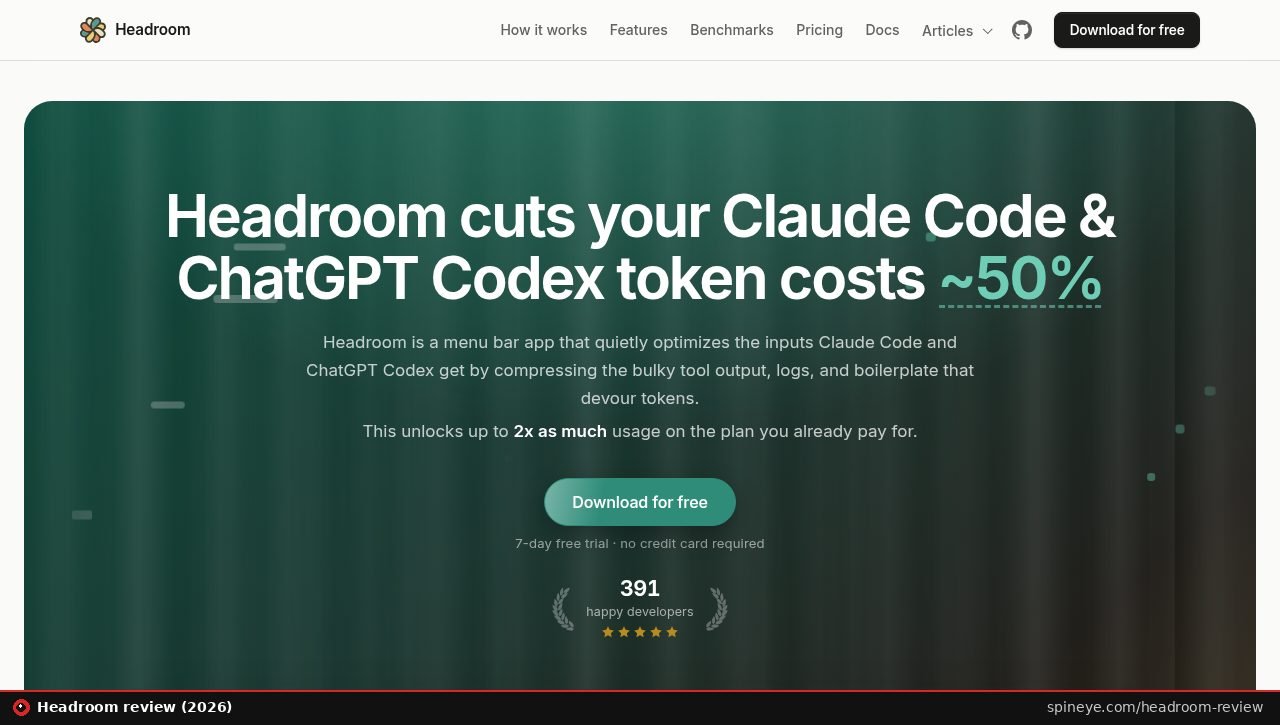
The desktop app comes from a small bootstrapped company in Amsterdam, founded on 1 April 2026 with 1–10 people. Founder Garm Lucassen says he struggled to install the Python package, asked its creator for a double-click app, and was told to build it himself under the same name (AppSumo founder post).
The open-source project is far bigger. Its repository, started by Tejas Chopra, showed 74.1k stars, 294 contributors and 172 releases on 29 September 2026, with v0.39.1 as the latest (github.com/headroomlabs-ai/headroom). It is Apache-2.0 licensed and installs with pip install "headroom-ai[all]" on Python 3.10 or newer. It has been on PyPI since early 2026.
When an AppSumo buyer asked whether the deal is “just a GUI”, the founder did not dodge it:
He adds that the app is built in coordination with the open-source creator, that he contributes pull requests, and that a payment agreement with the project is still being worked out. The vendor FAQ puts it plainly: you pay for the packaging, “not for the open-source engine itself” (extraheadroom.com/faq).
How Headroom works with Claude Code
The app points ANTHROPIC_BASE_URL and OPENAI_BASE_URL at a local port (127.0.0.1:6767). Your requests pass through Headroom, get compressed, and continue to Anthropic or OpenAI. You need a fresh terminal after switching it on. To remove it fully, use Settings > Uninstall Headroom; deleting the app does not undo every integration (AppSumo FAQ, extraheadroom.com/faq). The MCP mode is no substitute: automatic compression only happens in the proxy, the founder confirmed (source [7]).
Several desktop features are front ends for things the open-source tool already does. “Project learnings” mirrors the headroom learn command, which mines failed sessions and writes corrections into files such as CLAUDE.local.md and AGENTS.md (headroomlabs-ai/headroom README).
2How much does Headroom really save? Vendor claims vs independent measurements
Nobody agrees. The maker claims 25–50% fewer tokens per session. The open-source README says 20% for coding agents and 60–95% only for repetitive JSON. Independent users measured between 1.6% and 20.7% of tokens, and the largest test found 39% fewer tokens with no detectable drop in cost.
| Source | Type | Reported saving | What was measured |
|---|---|---|---|
| Headroom desktop site and FAQ | Vendor | 25–50% | “Typical coding sessions”; headline says ~50% and “up to 2x” usage |
| AppSumo FAQ | Vendor | 40–50% | “Overall session token usage”, up to 80% “on a good day” |
| Maker’s own Reddit account | Maker | 40–60% | “In most sessions” (r/ClaudeCode) |
| Open-source README | Vendor (OSS) | 20% / 60–95% | 20% for coding agents; 60–95% for JSON only; prose compresses “very little” |
| Brandon Barker, 25-task A/B | Independent | −39% tokens, ~0% cost | Prompt tokens 215M → 132M; mean saving inside run-to-run noise; 13 of 25 tasks cost more |
| Russ McKendrick | Independent | 20.7% | Dashboard token savings on ~1.9M tokens; content compression was ~5% of that |
| AI Coding Daily (YouTube), desktop app | Independent | “Really small” | About $2–4 saved against ~$117 of API-equivalent use in two days |
| Reddit r/ClaudeCode user | User | 3–5% | Compression seen in own setup |
| Reddit r/codex user | User | 1–2% | “Total token cost” |
| Reddit r/codex user | User | 1.6% | Input tokens, from a shared dashboard |
Vendor figures are the maker’s own claims. Sources: extraheadroom.com, AppSumo FAQ, headroomlabs-ai/headroom README, brandonbarker.me, russ.cloud, YouTube, Reddit threads linked in section 3.
Why the gap? Two reasons come up again and again. First, compression works best on bulky, repetitive output. The open-source README itself says short chats, prose and dense output see little or no reduction, and that the payoff is in long agent sessions with heavy tool output. Simple daily prompts will not show much.
Second, token savings are not cost savings. Anthropic already discounts cached prompt tokens heavily. If a proxy rewrites part of a cached prefix, that discount can be lost. In Barker’s A/B test, Headroom’s token mode caused 123 cache busts against 14 in the control, and the forfeited cache discount ($16.37) was larger than the metered saving ($15.41). Russ McKendrick found something similar from the other side: most of the dollars on his dashboard were Anthropic’s own cache discount, not Headroom’s compression.
The vendor claims the opposite on caching: its FAQ cites a ~97% prefix-cache hit rate, reported by the open-source maintainer, and a median latency of ~52 ms. It also admits your bill will not drop by the same percentage, and that Codex savings are lower than Claude Code savings because Codex already trims tool output (extraheadroom.com/faq). Both sides agree on one thing: measure it yourself. The founder’s advice is to compare your provider’s usage page with Headroom on and then paused.
3What users report about Headroom
Independent users are mostly underwhelmed. Several measured 1–5% savings on Reddit, two blog tests found real token reductions that barely showed up in cost, and a YouTube test of the paid app called the savings “really small”. The strongest numbers come from the maker’s own accounts. The AppSumo listing has no reviews yet.
In that same r/ClaudeCode thread, the account that says it builds the desktop app replied: “I get 40-60% savings in most sessions, and sometimes much more”. That is the maker speaking, not an independent user. Search snippets from two other threads mention around 10% (r/ClaudeAI, r/LocalLLaMA).
The same user worried that when caching breaks, Headroom could use more tokens and burn through subscription limits faster. Another commenter in that thread, u/TBT_TBT, put it more briefly: “I indeed think that “lossy” strategies can be counterproductive.” On r/codex, u/VadimH reported compression failures that made each request wait 30 seconds to time out while Codex tried to set it up (thread, May 2026).
The blog and video tests
Barker ran 25 Senior SWE-bench tasks with an API key. Solve rates stayed the same (5 of 25 against 4 of 25), so quality did not suffer. He notes the sample is small.
McKendrick measured about 300 ms of added overhead per request, with outliers, and liked headroom learn. Povilas Korop of AI Coding Daily is the only reviewer we found who tested the paid desktop app, for about two days on $20 Claude and Codex plans. His conclusion: “my savings in this case were like really small”. He also points out that the dashboard’s dollar figures are API-price estimates, not money off a subscription (YouTube, July 2026).
On GitHub, one user on the Claude Code CLI wrote that he was “not actually saving anything (and by anything I mean literally 0 tokens)”: about 9K tokens over 395 requests. That discussion has no maintainer answer (github.com/headroomlabs-ai/headroom/discussions/1099).
On AppSumo: no reviews, sharp questions
The deal had 0 reviews and 15 questions on 29 September. The questions are pointed. A Max x20 subscriber asked:
The founder answered that the core is compression for “up to 2x more usage”, that most users are on $20 plans, and that Max x20 users who are AppSumo Plus members can take the free annual deal and run it for three days before they need to upgrade.
4Headroom desktop vs free open-source Headroom vs Vexp
The paid app and the free proxy compress the same way; the app adds a one-click installer, a dashboard, updates and add-ons. Vexp works on a different layer: it changes which code your agent reads by indexing your repo. Headroom shrinks what is sent. The founder says the savings add up, but nobody has tested that.
| Criterion | Headroom app | Open-source Headroom | Vexp |
|---|---|---|---|
| What it is | Menu-bar app wrapping the proxy | Python/TS library, proxy, MCP server, headroom wrap for 15+ agents | Local code-context engine (dependency graph) |
| How it saves | Compresses tool output, logs, JSON, old turns | Same engine | Serves only the relevant code to the agent |
| Price | $29–$199 once (AppSumo) or $3–$40/mo | Free, Apache-2.0 | $49–$399 once (AppSumo) |
| Install | Double-click; no pip; ~2 GB runtime and model on first run | pip or uv, Python 3.10+, or Docker | VS Code extension and CLI |
| Claimed saving | 25–50% (vendor) | 20% coding agents; 60–95% JSON | “Up to 70%” (vendor) |
| Independent result | “Really small” (2-day YouTube test) | 1.6–20.7% tokens; ~0% cost in one A/B | Mixed; one reviewer measured 71% more tokens in a session |
| Dashboard | Menu-bar savings dashboard and activity feed | headroom dashboard / headroom perf | — |
| Data to the vendor | Device ID, email, plan, usage %, savings; Sentry and Aptabase | Local; prompts go only to your model provider | Zero network calls (vendor) |
| AppSumo reviews (29 Sep) | 0 | n/a | 30, average 4.57 |
Highlighted cells mark the stronger option on that row, based on the sources. Sources: Headroom on AppSumo, extraheadroom.com/faq, headroomlabs-ai/headroom README, Vexp on AppSumo and our Vexp review.
The founder was asked about Vexp twice on AppSumo. His framing: “VEXP *changes* what your agent reads. Meanwhile Headroom *shrinks* what your agent reads” (source [8]). He says both run side by side in VS Code and that the savings “add up rather than overlap” (source [9]). That is plausible in theory, since they touch different parts of the request. But it is a vendor claim, and both tools have independent tests that came in well below their headlines. Our Vexp review covers its measured results in detail.
Headroom vs RTK
RTK is the other free token saver Headroom users compare it with. AppSumo lists Headroom as an “alternative to RTK, Ponytail, Caveman”, and the desktop app itself offers RTK as a one-click add-on (extraheadroom.com/faq). We found no head-to-head measurement. What we did find: two Reddit users in section 3 tried Headroom and went back to RTK. If you already use RTK happily, Headroom has not been shown to beat it.
5Headroom payback calculator: does the lifetime deal pay for itself?
It depends almost entirely on the savings rate you believe. On a $20 plan, a 2% saving is worth about $0.40 a month and the $29 tier takes years to pay back. At the vendor’s 25–50%, it pays back in three to six months. Pick an assumption below and see.
6Headroom pricing in 2026: lifetime deal vs subscription
On AppSumo, Headroom costs $29 (Tier 1), $99 (Tier 2) or $199 (Tier 3) once, with a 60-day refund. Direct, it is $3, $15 or $30 a month billed annually, or $4, $20 or $40 monthly, after a 7-day free trial. Your tier follows your AI plan, not how much you use it.
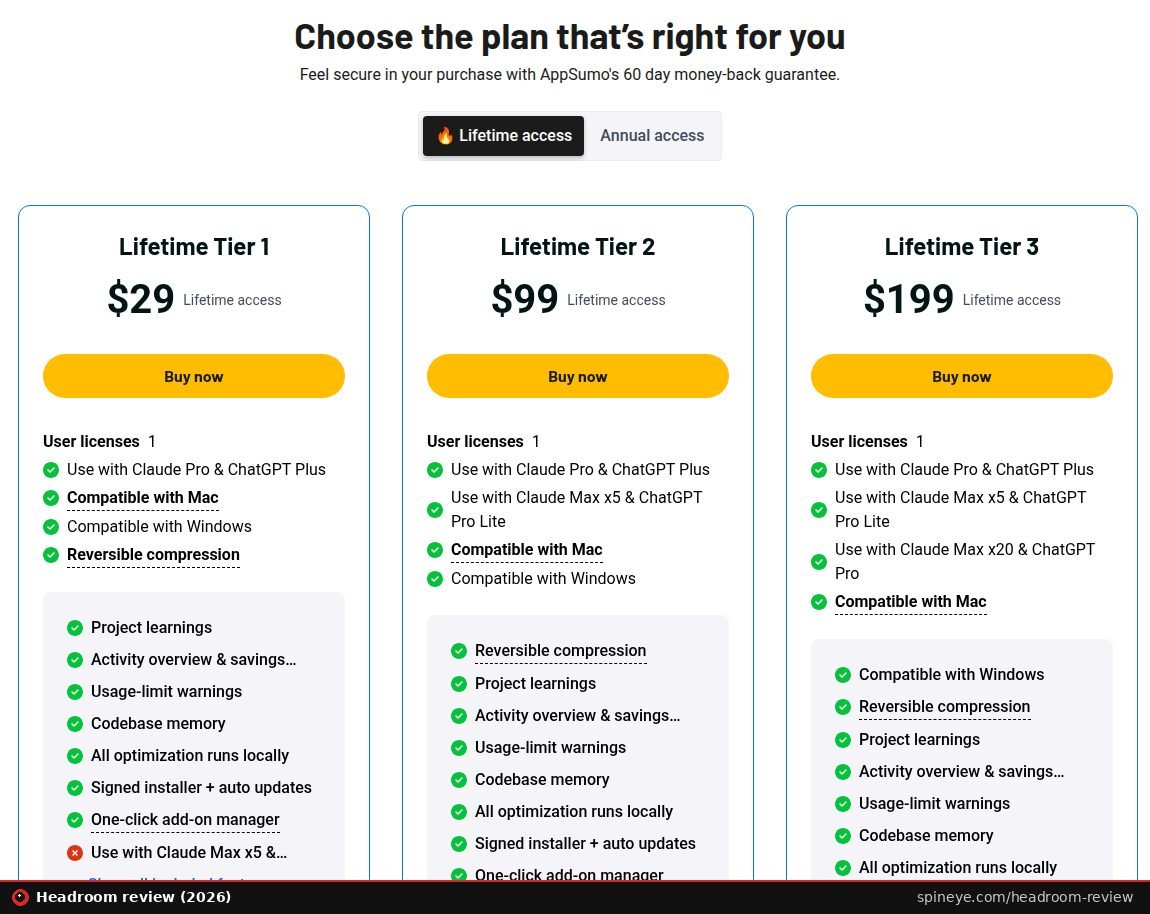
| Plan | For AI plan | Price | Break-even vs annual plan | Source |
|---|---|---|---|---|
| AppSumo Tier 1 (was $72) | Claude Pro / ChatGPT Plus | $29 once | ~10 months vs $3/mo | AppSumo |
| AppSumo Tier 2 (was $360) | + Claude Max x5 / ChatGPT Pro Lite | $99 once | ~6.6 months vs $15/mo | AppSumo |
| AppSumo Tier 3 (was $719.96) | + Claude Max x20 / ChatGPT Pro | $199 once | ~6.6 months vs $30/mo | AppSumo |
| AppSumo Annual Tier 1 | Pro, AppSumo Plus members only | $0 for 1 year | — | AppSumo |
| Direct Pro | Claude Pro / ChatGPT Plus | $3/mo annual, $4 monthly | — | extraheadroom.com |
| Direct Max x5 | Claude Max x5 | $15/mo annual, $20 monthly | — | extraheadroom.com |
| Direct Max x20 | Claude Max x20, priority support | $30/mo annual, $40 monthly | — | extraheadroom.com |
| Open-source Headroom | Any | $0 | — | Apache-2.0 |
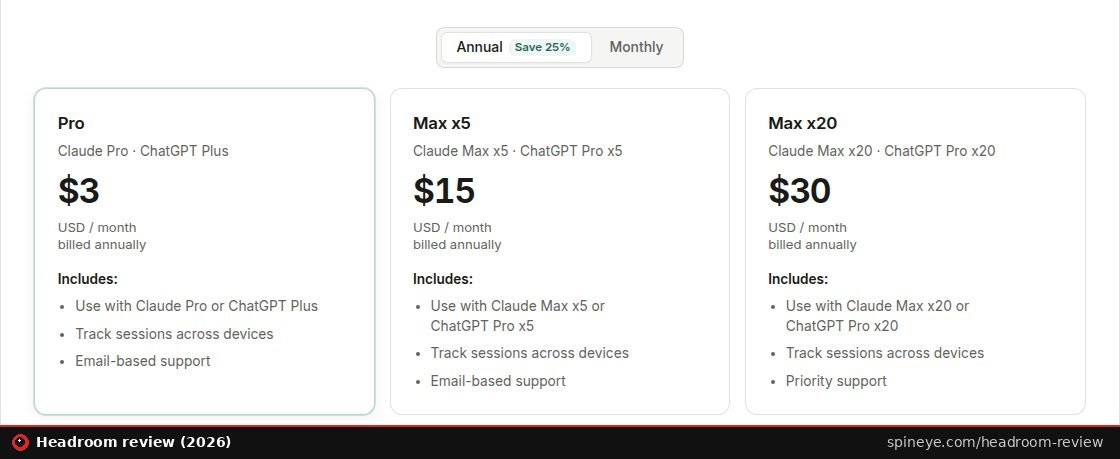
The tiering is unusual. Every tier includes the same features: reversible compression, project learnings, the dashboard, usage-limit warnings, codebase memory and the add-on manager. What changes is which Claude or ChatGPT plan it will run with. Claude Team seats count as Max x20, and if you use both Claude Code and Codex, the higher plan decides. If your plan is above your license, the app keeps working fully for 14 days, then a weekly usage limit applies until you upgrade (AppSumo FAQ).
A few deal terms to read before buying. The deal is for brand-new Headroom users only, you must activate within 60 days, and “access to future AI models may require an add on”. One license covers the same Claude Code or Codex account on several machines; a colleague with a different account needs their own license, at $29, $99 or $199 per extra seat (source [4]). Older prices you may see quoted, such as $30 a year or $5 a month, differ from today’s prices.
From $29 once for Claude Pro / ChatGPT Plus users, with a 60-day refund on AppSumo. Prefer free? The open-source proxy is on GitHub (headroomlabs-ai/headroom).
See the Headroom deal on AppSumo7Known problems and open questions (2026)
Because Headroom sits between Claude Code and Anthropic’s API, recent Claude Code versions turn off Remote Control and can show a false “Context low” warning. The maintainer says neither can be fixed in the proxy. A terms-of-service question is unanswered, the app phones home, and several popular clients are not supported.
- Remote Control is disabled. Claude Code 2.1.196 and newer switches off Remote Control whenever
ANTHROPIC_BASE_URLpoints at a non-Anthropic host. The issue was labeled High and closed as a duplicate. The vendor’s workaround: quit Headroom or start Claude withANTHROPIC_BASE_URL= claude(github.com/headroomlabs-ai/headroom/issues/1611, extraheadroom.com/faq). - False “Context low (0% remaining)”. One user on Claude Code 2.1.201 with a Max plan saw the warning pinned after a single “hi”. The maintainer called it “not something Headroom can fix in the proxy”, the same client-side feature gate (github.com/headroomlabs-ai/headroom/issues/1833).
- Terms of service: no answer. A GitHub discussion asking “Does headroom violate Claude code’s terms of service?” has been open since 5 July 2026 without a maintainer reply. We found no statement from Anthropic either (github.com/headroomlabs-ai/headroom/discussions/1814).
- Telemetry. Compression is local and prompts go only to your model provider. But the app sends your device ID, account email, Claude/ChatGPT plan, usage percentages and savings stats to Headroom’s server, crash reports to Sentry and app events to Aptabase (founder answer [3]).
- License server dependency. If the activation server shuts down, existing installs keep working, but “new sign-ins, new machines and reinstalls do need the server”, the founder says. That matters for a lifetime deal.
- Unsigned Windows build. The Windows app is not code-signed yet, so SmartScreen warns on first run. Linux needs glibc 2.39 (Ubuntu 24.04 or newer) (extraheadroom.com/faq).
- Not for every client. It does not work with the Claude desktop app (including its Code tab), Claude Chat or Cowork, or Cursor’s built-in models; in Cursor it only works through the Claude Code extension. Windsurf and Devin are not supported. One founder answer listed “Claude Desktop” as supported, but the FAQ and three other answers say it is not (source [5], source [6]).
- Mixed messages on usage tracking. The vendor FAQ says the app tracks your ChatGPT usage windows, while the founder told a buyer it does not show remaining Claude or ChatGPT usage, only what it saves (source [4]).
None of this is unusual for a tool that routes your traffic through a local proxy, but it is worth knowing before you point your coding agent at one. If you run agents on remote machines, our Jurniti review covers a different route to always-on agents. And the Huntarr incident is a reminder to check what any tool in your traffic path can see.
8Headroom pros and cons
Pros
- Double-click install, no pip or Python setup (extraheadroom.com/faq)
- Founder is open that it wraps the free open-source engine (source [2])
- Compression runs locally; prompts go only to Anthropic or OpenAI (source [3])
- Low entry price: $29 once, or $3 a month (source)
- Desktop source code is public under MIT, with frequent releases (github.com/gglucass/headroom-desktop)
- Quality held in an independent A/B: same solve rate with compression on (source)
Cons
- Independent savings far below the 25–50% claim (source)
- Fewer tokens did not mean lower cost in the largest test (source)
- Savings dashboard is the vendor’s own estimate (source [3])
- Breaks Claude Code Remote Control (issue #1611)
- Terms-of-service question unanswered (discussion #1814)
- Sends email, plan and usage stats to the vendor (source [3])
- No AppSumo reviews yet (source)
9Headroom review verdict (2026): who should buy, who should skip
Headroom is an honest product with an overselling headline. The app does what the founder says: it makes a popular open-source proxy easy to install and keep running, with a dashboard on top. What it cannot promise is the 25–50% saving on its homepage. Independent users mostly measured single digits, and the one careful A/B test found fewer tokens but no lower bill. At $29, the price of convenience is low. Just do not buy it expecting to halve your costs.
On a Max plan and an AppSumo Plus member? Try the free annual option before paying $99 or $199. And if your main problem is agents reading too much code, rather than bulky tool output, read our Vexp review first.
Get Headroom on AppSumoWhatever you choose, a token saver is one part of a sensible AI-coding setup. If you ship what your agent writes, our Vibe App Scanner review and Barrion review cover security checks for AI-built apps. And for Claude users who want their agent to handle admin too, our Accordio review looks at a Claude-connected back office.
How we researched this Headroom review
- Read the Headroom AppSumo listing, deal terms, FAQ and all 15 buyer questions with the founder’s answers (checked 29 September 2026).
- Compared the desktop site’s pricing, FAQ and savings claims with the open-source README and the desktop repository.
- Collected independent measurements: two blog tests of the open-source proxy, one YouTube test of the desktop app, Reddit threads and GitHub issues and discussions.
- Where sources disagree, we show the range instead of picking one number. Savings figures from the maker, including its Reddit account, are labeled as such.
- This Headroom review relies on public reports for savings figures; results on your own workload will differ.
Headroom FAQ
How much does Headroom cost on AppSumo?
On 29 September 2026: $29 (Tier 1), $99 (Tier 2) or $199 (Tier 3) once, with a 60-day refund. The tier has to match your highest AI plan (Pro/Plus, Max x5/Pro Lite, Max x20/Pro). AppSumo Plus members can also claim one free year of Pro.
Is the open-source Headroom free, and what does the paid app add?
Yes. The open-source proxy is Apache-2.0 and installs with pip. The desktop app bundles it with a no-pip installer, a menu-bar savings dashboard, auto updates, one-click add-ons and a GUI for learnings. The founder calls it a GUI built around the open-source project.
How many tokens does Headroom really save?
The claims are far apart. The vendor says 25–50% per session. The open-source repo says 20% for coding agents and 60–95% only for JSON. Independent users measured 1.6% to 20.7% of tokens, and one A/B test found 39% fewer tokens but no detectable change in cost.
Can I trust the Headroom savings dashboard?
Only as an estimate. The founder says input savings are Headroom’s own estimate. One independent A/B test found the open-source meter overstated savings by about 1.9x on cached workloads. Compare your provider’s usage page with Headroom on and then paused.
Does Headroom break anything in Claude Code?
Yes. Since Claude Code 2.1.196, Remote Control is disabled whenever ANTHROPIC_BASE_URL points at a proxy. One issue also reports a false “Context low (0% remaining)” warning. The maintainer says neither can be fixed in the proxy.
Is using Headroom against Claude Code’s terms of service?
Unclear. A GitHub discussion asking exactly this has had no maintainer answer since 5 July 2026. Headroom works by routing your Claude Code traffic through a local proxy.
Does my code leave my machine?
Compression runs locally and prompts go only to Anthropic or OpenAI. The desktop app does send your device ID, account email, plan, usage percentages and savings stats to Headroom’s server, crash reports to Sentry, and app events to Aptabase.
Headroom vs RTK: which should I use?
There is no head-to-head measurement. RTK is one of the add-ons the Headroom app installs with one click, and two Reddit users who tried Headroom went back to RTK. If RTK already works for you, Headroom has not been shown to beat it.
Headroom or Vexp, or both?
They work at different points. Vexp changes what code the agent reads by indexing your repo. Headroom compresses what is sent: tool output, logs and history. The founder says the savings add up, but nobody has tested that independently.
Is Headroom the same as “Headroom – Know Your AI Limits”?
No. That is an unrelated App Store app with a similar name. This review covers the Headroom desktop app from extraheadroom.com, built on the open-source Headroom proxy.
Sources
- AppSumo — Headroom listing, plans, FAQ and deal terms (checked 29 Sep 2026). link
- AppSumo Q&A — “Just a GUI?” (founder, 28 Sep 2026). link
- AppSumo Q&A — seven questions: telemetry, cache, license server, savings estimate (founder, 28 Sep 2026). link
- AppSumo Q&A — usage remaining and multiple computers. link
- AppSumo Q&A — Claude Chat support. link
- AppSumo Q&A — Cursor support. link
- AppSumo Q&A — proxy mode and lazy loading. link
- AppSumo Q&A — comparison to Vexp (founder, 29 Sep 2026). link
- AppSumo Q&A — working alongside Vexp. link
- AppSumo Q&A — “What’s the point of the free deal?” (29 Sep 2026). link
- Headroom desktop — homepage, pricing and FAQ. extraheadroom.com, extraheadroom.com/faq
- Headroom desktop — source repository (MIT). github.com/gglucass/headroom-desktop
- Headroom open source — repository and README (Apache-2.0). github.com/headroomlabs-ai/headroom
- GitHub issue #1611 — Remote Control disabled. github.com/headroomlabs-ai/headroom/issues/1611
- GitHub issue #1833 — false “Context low”. github.com/headroomlabs-ai/headroom/issues/1833
- GitHub discussion #1814 — Claude Code terms of service (unanswered). github.com/headroomlabs-ai/headroom/discussions/1814
- GitHub discussion #1099 — negative savings. github.com/headroomlabs-ai/headroom/discussions/1099
- Brandon Barker — “Headroom: fewer tokens, bigger bill” A/B test (28 Jul 2026). link
- Russ McKendrick — “Playing with Headroom” (13 Jun 2026). link
- AI Coding Daily (Povilas Korop) — desktop app test on YouTube (24 Jul 2026). youtube.com/watch
- LiteLLM — Headroom integration blog (30 Jun 2026). link
- Reddit r/ClaudeAI — “Has anyone tried using Headroom?”. link
- Reddit r/ClaudeCode — “Headroom setup” (Mar 2026). link
- Reddit r/codex — savings report (Jun 2026). link
- Reddit r/codex — “Question on headroom + Codex” (Jun 2026). link
- Reddit r/codex — Codex setup and timeouts (May 2026). link
- Reddit r/LocalLLaMA — Headroom discussion. link
- AppSumo — Vexp listing (checked 29 Sep 2026). link
AI assistance was used for research and drafting; every fact was checked against the listed sources. Prices and figures checked 29 September 2026.