
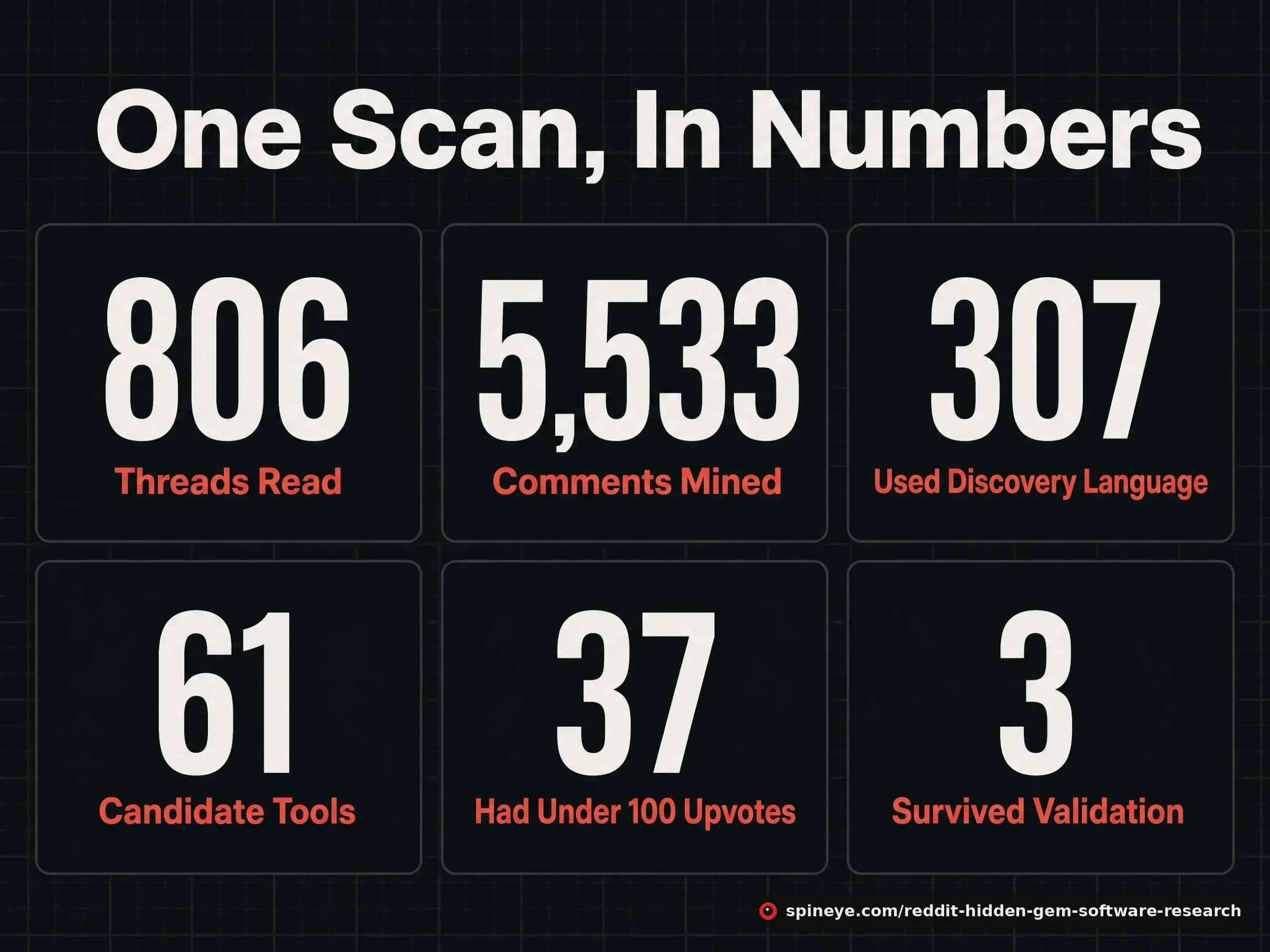
We read 806 Reddit threads and 5,533 comments looking for hidden gem software — tools people love but nobody has reviewed. The most useful thing we learned had nothing to do with any particular tool: the best finds were the quietest ones. Of the 61 candidate tools that survived filtering, 37 came from posts with fewer than 100 upvotes — and the single best find had 24.
Ben-G — independent reviewer at Spineye. This is original research: our own data, our own method, and the limitations stated plainly. How we review · LinkedIn
Updated 8 August 2026: a second round of scanning across ten more communities is summarised at the end of this piece.
What We Were Looking For
There is a category of software that is genuinely good, has a small group of devoted users, and has essentially no coverage: no reviews, no comparison articles, nothing but the developer’s own page and a directory listing. Those tools are hard to find precisely because nobody writes about them. The only reliable trace they leave is someone in a niche community saying, in effect, look what I found.
So we went looking for that phrasing rather than for tool names. Twelve queries built around discovery language — “hidden gem”, “underrated”, “nobody talks about”, “just discovered”, “best kept secret”, “obscure tool”, “why is this not more popular” — run across ten communities where practitioners actually discuss what they use.
The Method, In Full
Reproducibility matters more than cleverness here, so the whole thing is four steps:
2. Mine — pull top comments from every thread showing discovery language (tool names live in replies, not titles)
3. Extract — collect candidates from GitHub repository links, standalone domains, and names in context (“try X”, “switched to X”)
4. Filter — drop a hard list of roughly 180 mainstream names, then weight discovery language three times heavier than raw frequency
That final weighting is the part that matters, and we only added it after the first run produced a list topped by tools everyone already knows. Which brings us to the first finding.
Finding 1: Frequency Ranking Always Returns the Famous
Rank raw mentions and you get Nextcloud, Jellyfin, Immich, Obsidian and Home Assistant — excellent software, all of it, and all of it reviewed to death. Popularity and obscurity are measured by the same signal, so the metric that finds one drowns out the other.
The fix was blunt: an exclusion list of about 180 names covering the saturated categories — the self-hosted classics, the *arr suite, the note-taking apps, the automation platforms, the well-covered Mac utilities. Only after that filter did anything interesting surface. If you run this kind of search yourself, budget real time for the exclusion list; it is not a footnote, it is the mechanism.
Finding 2: The Best Finds Are Quiet
This is the result that changed how we read the data. Of 61 surviving candidates, 37 came from threads with fewer than 100 upvotes. The tool we eventually rated highest for opportunity — Brows3, a free S3 browser — was posted in a thread with 24 upvotes.
“I stumbled across this as it seems it’s the only free, cross platform option and it’s actually REALLY nice. Hidden gem! I’m hoping it gets more exposure.”
r/selfhosted, May 2026 — 24 upvotesThat makes sense once you say it out loud. A thread with thousands of upvotes is, by definition, no longer a secret; the tool in it has already been seen by everyone who cares. A thread with two dozen upvotes is one person telling a small room. If you are hunting for things the wider world has missed, high engagement is a signal you are late, not a signal of quality.
Finding 3: Discovery Language Is Common, and Mostly Noise
Of 806 posts, 307 — about 38% — contained discovery language somewhere. That is far too many to be genuine finds, and the distribution shows why.
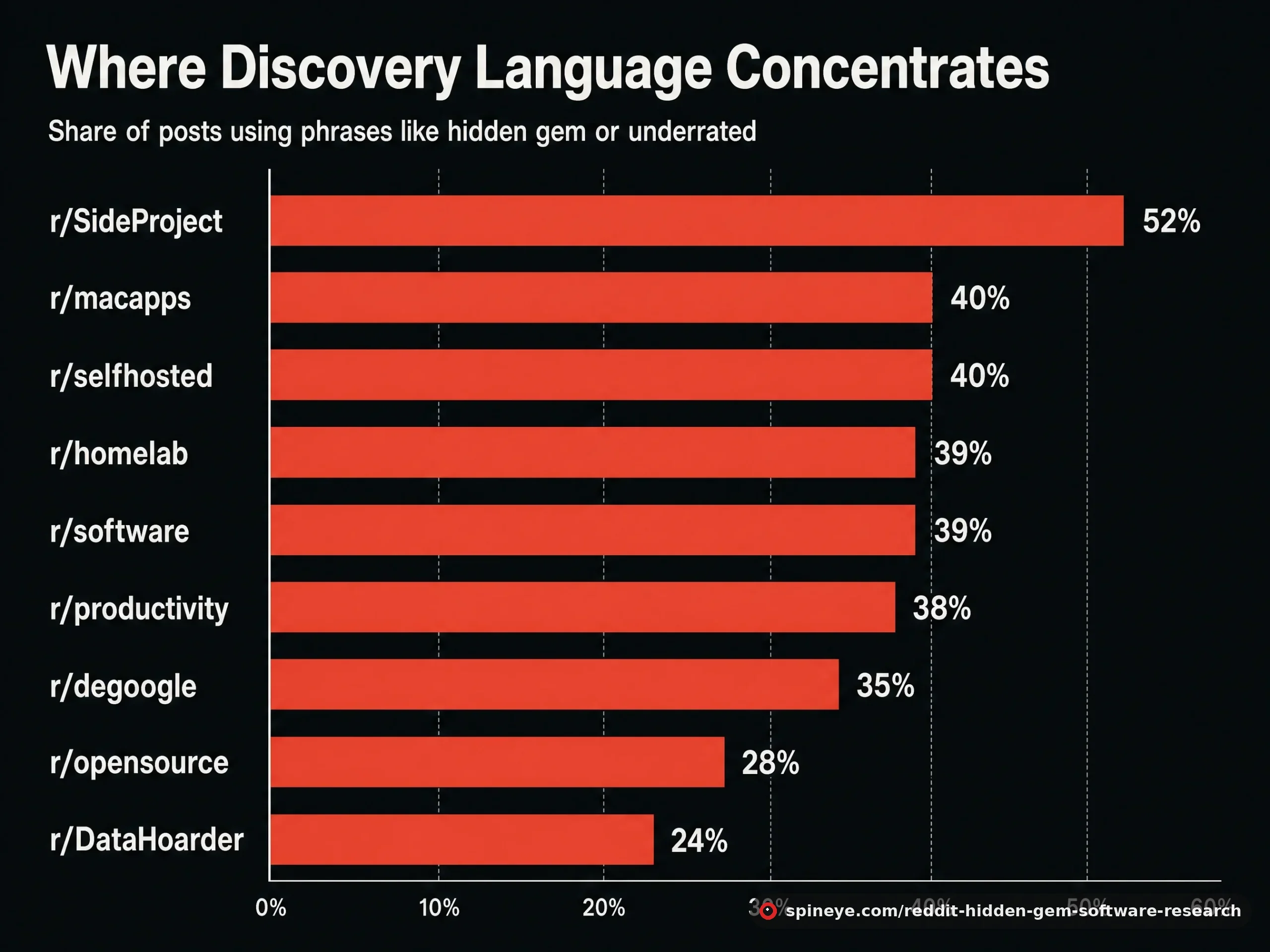
| Community | Posts | Discovery language | Share |
|---|---|---|---|
| r/SideProject | 119 | 62 | 52.1% |
| r/macapps | 104 | 42 | 40.4% |
| r/selfhosted | 97 | 39 | 40.2% |
| r/homelab | 85 | 33 | 38.8% |
| r/software | 93 | 36 | 38.7% |
| r/productivity | 66 | 25 | 37.9% |
| r/degoogle | 92 | 32 | 34.8% |
| r/opensource | 67 | 19 | 28.4% |
| r/DataHoarder | 76 | 18 | 23.7% |
r/SideProject tops the table at 52% — and is the least useful of the nine. That community is where developers announce their own work, so the enthusiasm is the author’s, not a user’s. The language pattern is identical; the evidential value is not. Every candidate from there needed a second, independent mention before we took it seriously.
The two rows we highlighted, r/macapps and r/selfhosted, sit slightly lower at around 40% but produced almost everything that survived. The difference is who is speaking: in those threads, the enthusiasm belongs to someone who installed the thing and came back to say so.
The rule we ended up with
Discovery language from the author of a tool is marketing. The same words from a third party in a reply are evidence. Extract from comments, not from post titles — and treat any community built around launches as a lead source, never as proof.
Finding 4: A Mention Is Not a Gap
Sixty-one candidates sounds like a lot of opportunity. It was not. Every candidate then had to clear a second, harsher test: does independent coverage already exist?
Most failed. Applite, a Homebrew GUI, had already been written up by MakeUseOf and discussed on Hacker News. Wealthfolio, a local-first investment tracker that looked ideal on Reddit signal alone, turned out to have three or four independent reviews. AppAddict ranked near the top of our extraction — until we realised it is itself a review blog, not a tool. Since the scan, Lidify and Find Any File have both picked up coverage from major sites, which is exactly how fast these windows close.
Three cleared everything:
| Tool | What it is | Why it survived |
|---|---|---|
| Brows3 | Free open-source S3 browser for Windows, macOS and Linux | Own site plus a single review. The cleanest gap we found. |
| Dawarich | Self-hosted alternative to Google Timeline | Real demand after Google’s changes; results dominated by hosting providers, not reviewers. |
| Easydict | Free macOS translator with offline OCR and 20+ engines | 14,200 GitHub stars and a results page made almost entirely of directory listings. |
Three out of sixty-one is a 5% hit rate. That is worth knowing before you start: this method is a filter, not a firehose.
Where This Method Breaks
Stating the limits is not modesty, it is the difference between research and content.
- It only finds what somebody posted. Genuinely undiscovered software — the kind with a dozen users and no Reddit presence — is invisible to this approach by construction.
- One platform, one language. Reddit skews English-speaking, technical and Western. Tools popular on Chinese, Japanese or Russian forums do not appear. Easydict, notably, has Chinese-first documentation and surfaced only through its English-speaking users.
- Upvotes are a weak proxy. Low engagement is what we were hunting, but it also correlates with things being ignored for good reasons. Every candidate still needed reading, not just counting.
- It is a snapshot. Coverage moves fast — two of our own candidates gained major-site coverage within weeks of the scan.
- The exclusion list encodes a judgement. We decided which ~180 names count as “mainstream”. Draw that line differently and you get a different shortlist.
How to Run This Yourself
Nothing here needs paid tooling. Reddit’s public search is readable without credentials, so the whole scan is a modest script. The pieces that actually determine whether it works:
- Pick communities where people use software, not where they launch it. Practitioner subreddits beat maker subreddits for evidence quality.
- Search language, not names. You cannot search for a tool you have never heard of; you can search for how people talk about finding one.
- Mine the comments. Titles ask questions; replies contain answers, and answers contain names.
- Build the exclusion list first. Without it, your top results are whatever is already famous.
- Validate before you invest. Search “[tool] review” for each candidate. If a major site already covered it, move on — the window has closed.
Why We Published the Method
Handing over the approach that finds our articles is not an obvious business decision. We did it because the alternative — asserting that our picks are good and asking you to take our word for it — is precisely the thing that makes most review sites worthless. A method you can inspect, criticise and run yourself is a stronger claim than any score we could print.
If you run it and find something we missed, that is a good outcome. The tools in this piece deserve more users; that was the whole point of the thread that started it.
Update: A Second Round Confirmed the Rule
After publishing this, we ran the same method across ten different communities — the privacy, Linux, Android and developer corners we had not touched: r/coolgithubprojects, r/PrivacyGuides, r/privacy, r/linuxapps, r/androidapps, r/FOSS, r/commandline, r/sysadmin, r/homeassistant and r/webdev. That brought the combined total to 1,299 threads and 9,912 comments across twenty communities.
The second round was less productive than the first, and the reason is instructive: developer-heavy communities discuss ecosystems more than individual tools, so the extraction returns frameworks and platforms rather than discoverable apps. r/linuxapps and r/PrivacyGuides returned almost nothing usable. The clear exception was r/androidapps, which was as rich as anything in round one.
But the most useful result was a test of our own rule. The two quietest candidates with the strongest discovery signal — one with ten upvotes, one with two — looked, on paper, exactly like the kind of find this method exists for. Reading them settled it: both posts opened with “I built an open-source alternative to…”. They were their authors announcing their own work. Our rule — discovery language from the author is marketing, the same words from a third party are evidence — correctly disqualified both. The filter did its job on data it had never seen.
That is the real payoff of writing the method down. A rule you can state is a rule you can test against new data, and this one held. The one tool that survived round two — Next Player, a free Android video player with 4,200 stars and no independent coverage — came, predictably, from a genuine third-party thread asking which apps are underrated, not from anyone promoting their own.
Update: Two More Rounds, and a Negative Result
We kept running the method. A third round went deeper into the Android communities that round two had flagged as the richest seam. A fourth round did the opposite: ten communities deliberately outside the Android and self-hosted world, to see whether the approach travels — r/ObsidianMD, r/PKMS, r/Zettelkasten, r/chrome_extensions, r/windowsapps, r/Windows11, r/DigitalMinimalism, r/NAS, r/HomeServer and r/freesoftware. Across all four rounds that is 2,457 threads and 26,060 comments from 37 communities.
The fourth round produced no publishable find. We are reporting it anyway, because a method that only gets described when it works is marketing.
The numbers explain why. In round one, 38% of threads carried discovery language. In round four it was 10.4%. The gap is not subtle: the best community in round four (r/ObsidianMD, 16.2%) still scored below the worst community in round one (r/DataHoarder, 23.7%). Where you look matters more than what you search for.
The reason is structural. Plugin and extension ecosystems are announcement channels. Almost every candidate that cleared our self-promotion filter traced back to a release post by the person who wrote the software — “Operon is live”, “Task Board v1.9.0”, “Notebook Navigator 2.4”, “I built a modern, open-source photo manager for Windows”. These are healthy communities. They are simply not places where users discover each other’s finds; they are places where makers ship.
Two failures were our own, and both are worth stating. First, r/NAS scored the highest discovery ratio of the entire round at 36.4% — and it was an illusion. The searches had matched conversations about the rapper Nas, not network-attached storage. A homonym walked straight through the filter. Second, one “tool” surfaced repeatedly across three communities with no self-promotion attached, which by our own scoring looked promising. It was a Reddit content-deletion service that leaves its own URL behind in every comment it erases. Not a recommendation at all — an artefact of how people scrub their posting history.
Only one name in the round came from a genuine third-party mention inside someone else’s thread: PicView, a Windows image viewer. It is a fair review target on coverage grounds, but it is a nine-year-old project with 3,400 stars and listings on every download portal — proven demand with thin reviewing, which is a different thing from a hidden gem. We have kept it on the list and labelled it honestly.
The rule from round two survived contact with an entirely new domain. What round four added is a boundary condition: the method finds tools where users talk to each other about what they found, and returns noise where developers talk to users about what they shipped. Both are worth knowing before you spend a week scanning the wrong forum.
Frequently Asked Questions
How many Reddit threads did this research cover?
806 threads across ten subreddits, restricted to roughly the previous twelve months, plus 5,533 comments mined from the 270 threads that showed discovery language.
Which subreddits were scanned?
r/selfhosted, r/opensource, r/SideProject, r/macapps, r/homelab, r/software, r/productivity, r/degoogle, r/InternetIsBeautiful and r/DataHoarder.
What is “discovery language”?
Phrases people use when they have found something they did not expect: “hidden gem”, “underrated”, “nobody talks about this”, “just discovered”, “best kept secret”, “why is this not more popular”. Searching for these instead of tool names is how you find software whose name you do not know.
Why exclude popular tools?
Because ranking by mention count returns whatever is most popular, which is the opposite of what we were looking for. An exclusion list of roughly 180 mainstream names was necessary before anything under-covered could surface.
Do high-upvote threads find better tools?
Not for this purpose. 37 of our 61 candidates came from threads under 100 upvotes, and the strongest find had 24. High engagement means a tool has already been widely seen.
How many candidates were actually worth writing about?
Three of sixty-one — about 5%. The rest either already had independent coverage, were not really tools, or lacked enough substance to review honestly.
Can I reproduce this research?
Yes. Reddit’s public search needs no credentials, and the method is four steps: search discovery language across chosen communities, mine comments from matching threads, extract candidate names, then filter out mainstream tools and validate the survivors against existing coverage.
What are the biggest weaknesses of this approach?
It only finds tools somebody has already posted about; it covers one English-language platform; upvote counts are a crude proxy; and it is a snapshot — two candidates gained major-site coverage within weeks of our scan.
Sources and Data
All figures come from our own scan, run in August 2026 using Reddit’s public search across the ten communities listed above. Tool-specific claims are sourced in the individual reviews: Brows3, Dawarich and Easydict. For a related look at what happens when a self-hosted project’s trustworthiness is called into question, see our analysis of the Huntarr incident. More of this work lands in the Spineye blog.