

This article contains affiliate links. Purchases through these links may earn us a commission at no extra cost to you.
This Vexp review answers one question first: does it really cut your AI coding bill by 70%? The honest answer is that it depends on your editor and your codebase. The maker’s own numbers range from 87% down to 8%, and one careful buyer measured the opposite in Claude Code.
Based on Vexp’s documentation, pricing and published benchmark, and the AppSumo listing with its 29 verified reviews and 107 questions. We also used the VS Code Marketplace, a Claude Code discussion on Reddit, and Anthropic’s own cost guidance. Alternatives are described from their GitHub pages. Last updated: September 2026.
Vexp review verdict (2026)
Vexp is a well-built, local-first context engine with a fast index, useful impact analysis and a founder who answers critical questions openly. Buyers rate it 4.52 out of 5 on AppSumo. Its headline savings, however, come from its own counter, which measures how much smaller its answers are, not what your whole session costs.
Key Takeaways
- Vexp builds a local dependency graph of your code and serves AI agents only the relevant parts, with zero network calls. (vexp.dev [1])
- The lifetime deal costs $49 to $399 once; the regular Pro plan is $19 a month. (AppSumo)
- Savings claims vary widely: 87% per call, 70% overall, and 8% session cost in the maker’s own v3.0 test. (VS Marketplace [3])
- A Tier 4 buyer measured one Claude Code session using 71% more tokens with Vexp; the maker fixed the missing hook he found. (AppSumo reviews [5])
- Anthropic puts the average Claude Code bill at about $13 per active day, and its free tips (/clear, /compact, a short CLAUDE.md) come first. (Anthropic)
1What is Vexp?
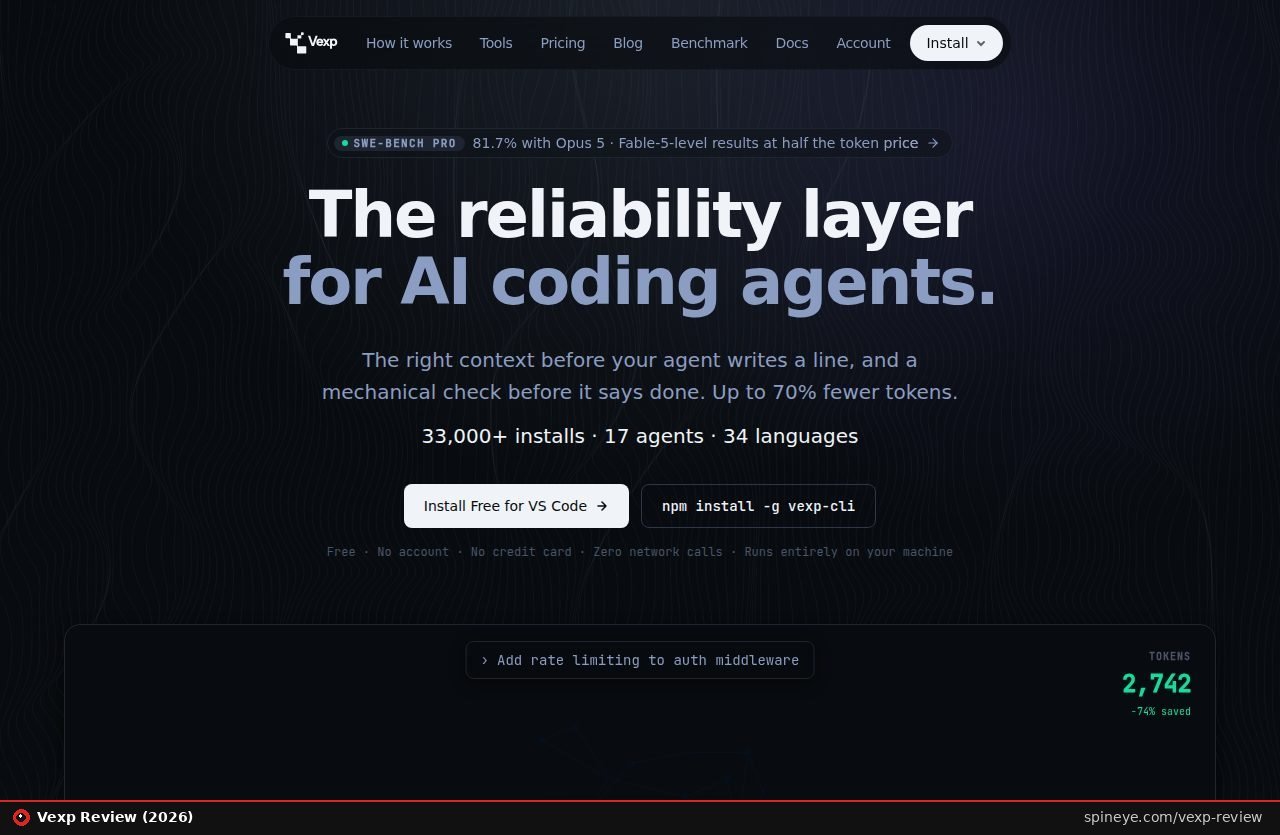
Vexp is a context engine for AI coding agents such as Claude Code, Cursor, Copilot and Codex. It parses your code into a dependency graph on your own machine and, through an MCP server, hands the agent only the functions and files that matter for a task. The goal is fewer wasted tokens and fewer wrong edits.
Under the hood, Vexp uses tree-sitter to turn your code into a graph: functions, classes and types become nodes, calls and imports become edges. Everything is stored in a local SQLite file. Secrets are filtered out by default and nothing is uploaded (vexp.dev [1]).
When the agent asks for context, Vexp searches the graph and returns “pivot” files in full, with neighbouring code reduced to signatures. The maker quotes a full index in under 15 seconds and queries in under half a second. One buyer confirmed the speed: about 900 TypeScript files indexed in under 30 seconds (AppSumo reviews [5]).
Vexp exposes 12 MCP tools. The main one runs context search, impact analysis and memory recall in a single call. Others show the “blast radius” of a change, trace a call path between two functions, and check the agent’s work before it says it is done. It works with 17 agents, including Claude Code, Cursor, Windsurf, Copilot, Codex and Zed.
The company is young. Vexp was founded in February 2026 in Milan, Italy, and is a bootstrapped team of 1–10 people led by founder Nicola Alessi, according to its AppSumo profile. Local-first privacy is a theme we like on Spineye, from note-takers like Prismical to the lessons in our Huntarr security incident piece about trusting tools with your data.
2How much does Vexp really save?
It depends on what you measure. Vexp’s own counter compares its compact answer with reading whole files, which is where 70–87% comes from. Measured on a full session, the maker’s v3.0 test found 13% less context replay and 8% lower cost, rising to about 20% on long sessions. Buyers report anything from 30% to 88%.
The difference matters. Vexp’s savings counter answers the question “how much smaller is this context than the files it replaces?” It cannot see whether the agent then reads those files anyway. The v3.0 test answers a different question: what did the whole session cost? In that test, sessions with Vexp also solved more tasks, 24 of 25 against 22 of 25 (VS Marketplace [3]).
The buyer who measured it himself
The most useful review on AppSumo comes from a Tier 4 buyer who spent two days measuring Vexp in Claude Code. In four sessions, Claude Code called a Vexp tool only once, after he added an instruction to CLAUDE.md. That session used 71% more tokens than the same task without Vexp.
“If you are comparing tools, do not use that percentage as your evidence — measure your own sessions.”— thomklin, Tier 4 buyer, AppSumo review [5], August 2026
His explanation is fair to both sides. Claude Code already ships its own search tools and reaches for them first, so the two overlap. He also found that setup did not install the Claude Code hook that should inject context automatically. The founder replied within a day, called the missing hook a real defect and says it is fixed. The reviewer concluded that Vexp suits editors without strong built-in code search better, such as Copilot, Continue and Cursor.
The benchmark on Vexp’s site needs the same care. Claude Code with Opus 5 and Vexp resolved 81.7% of 731 SWE-bench Pro tasks at $1.52 per task. Vexp itself notes that no run without Vexp was published on the same setup, so its own contribution is not isolated (Vexp benchmark [2]).
3How to reduce Claude Code token usage (with or without Vexp)
Start with the free habits Anthropic recommends. Clear context between tasks, compact long sessions with a focus, keep CLAUDE.md short, switch off unused MCP servers and hand verbose work to subagents. Add a context engine like Vexp only for large existing codebases, and measure the result from your own usage data.
Anthropic says the average Claude Code user spends about $13 per active day and $150–250 a month. Nine in ten users stay below $30 per active day (Anthropic cost guide). These steps come from that guide, plus the lesson from the Vexp measurements above.
- Measure first. Note what a typical task costs today, from your usage data or session transcript. Do not rely on a plugin’s own savings counter, as the AppSumo reviewer showed.
- Use /clear between unrelated tasks. Old context is replayed on every turn, so starting fresh is the cheapest saving there is.
- Compact with a focus. Tell /compact what to keep, for example “focus on code samples and API usage”, so the summary stays useful.
- Keep CLAUDE.md under about 200 lines. Move specialised instructions into skills that load only when needed.
- Switch off MCP servers you are not using. Check them with /mcp, and prefer command-line tools when they do the same job.
- Hand verbose work to subagents. Their long output stays in their own context; only a summary returns to your main session. Simple subagent tasks can run on a cheaper model such as Haiku.
- Then consider a context engine. Tools like Vexp or Serena help most in large, existing codebases. For a new project, a Reddit commenter in r/ClaudeCode notes that clear planning up front saves more (Reddit).
- Check that the agent actually calls it. If you add Vexp to Claude Code, confirm in the transcript that its tools are used, and compare the cost with your baseline from step 1.
The same “measure, then decide” logic runs through our Honeylog review, where server logs show what AI crawlers really do rather than what dashboards suggest.
4What do users say about Vexp?
Most AppSumo buyers are enthusiastic: 23 of 29 give five tacos, praising the savings counter, impact analysis on large codebases and fast, personal support from the founder. The critical reviews concern Claude Code integration, a shared licence key on the 10-seat tier, and node limits that confuse new users.
The positive reviews quote the savings counter often: 77% over 17 calls, around 88% over a weekend, 62% on a 4,500-node repo. One API user reports about 30% lower costs in a week. Others praise impact analysis, with one buyer saying it “finds bugs that text search realistically cannot”. Several single out the founder’s support, including a free seven-day unlimited trial for one enterprise tester (AppSumo reviews [5]).
The criticism
Apart from the Claude Code measurement above, two issues stand out. A two-taco review from September says the “10 seats” of Tier 4 share a single licence key that cannot be rotated or revoked. In practice, a former employee could keep using a paid seat. A four-taco review warns that Vexp is for coding only: pointing it at a general projects folder blew past the node limit, and the documentation did not explain the fix. On the VS Code Marketplace the extension scores 5 out of 5 from 20 ratings, with 3,978 installs; Vexp itself counts 33,000+ installs across all channels.
If you run AI agents on your own infrastructure, our jurniti review covers the hosting side, and our Accordio review looks at a back office built around Claude. Before you ship what your agent built, our Vibe App Scanner review explains what to check for security.
5How much does Vexp cost in 2026?
On AppSumo, Vexp costs $49, $119, $199 or $399 once, with a 60-day refund. The tiers differ in nodes (10,000 to unlimited), seats (1 to 10) and linked repositories. Outside the deal there is a free plan for small projects, Pro at $19 a month and Team at $29 per seat.
| AppSumo tier | Price (list) | Nodes | Seats | Repos per workspace |
|---|---|---|---|---|
| Tier 1 | $49 ($100) | 10,000 | 1 | 1 |
| Tier 2 | $119 ($240) | 50,000 | 1 | 3 |
| Tier 3 | $199 ($1,800) | 100,000 | 5 | Unlimited |
| Tier 4 | $399 ($3,600) | Unlimited | 10 | Unlimited |
Source: AppSumo, checked 25 September 2026. Tiers 1–2 receive future Pro updates, Tiers 3–4 future Team updates.
The plan cards also show smaller differences. Tier 1 lacks the shared workspace and git index, and Tiers 1 and 2 lack priority paths and analytics. Intent detection, the LSP bridge and session memory are included on every tier.
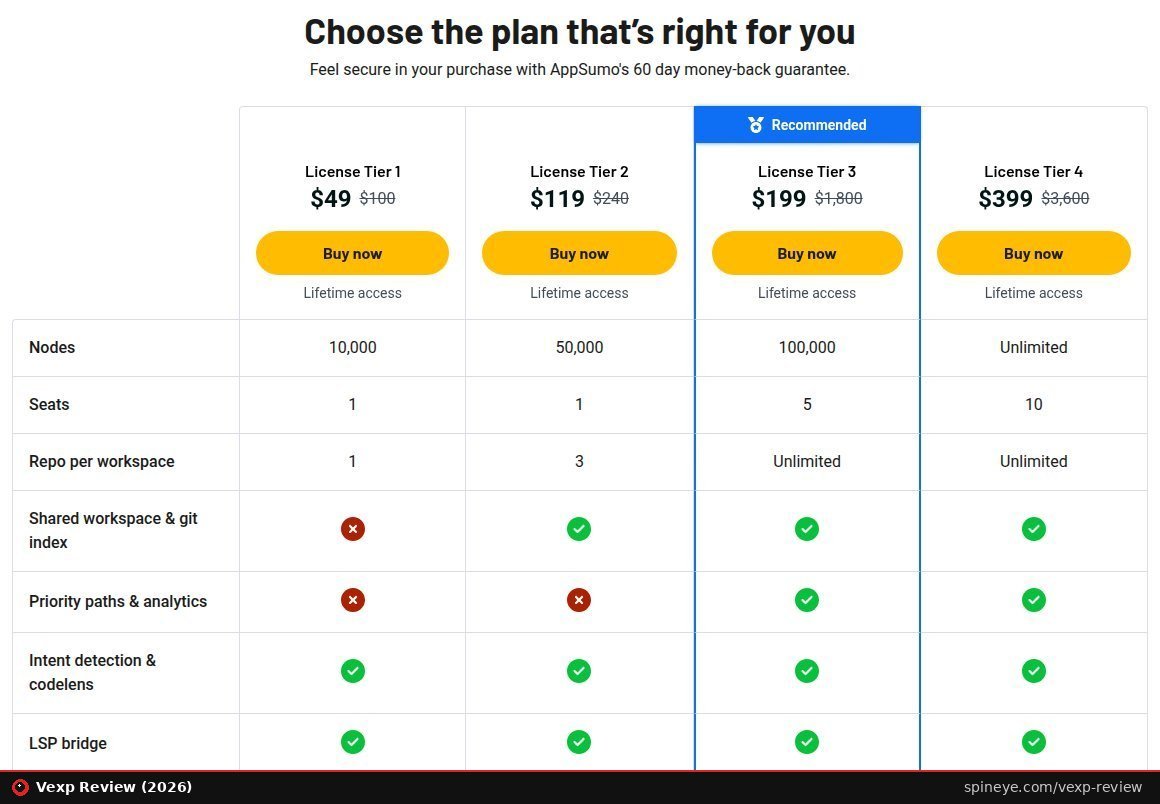
A node is one function, class or type, so the node count measures how big a project is. Individual projects are unlimited on every tier; the repo limit only applies to repositories linked in one workspace. The maker’s advice is to run the free plan first and watch the node count. For comparison, the free Starter plan covers up to 2,000 nodes and 20 calls a day, and Pro allows 50,000 nodes and 1,000 tool calls a day (vexp.dev [1]).
Tier 1 is $49 once for 10,000 nodes and one seat, with a 60-day refund — enough time to measure your own sessions.
See the Vexp deal
6Vexp vs Serena vs Claude Context
Serena is a free, open-source MCP toolkit that uses language servers for symbol-level retrieval and editing. Claude Context from Zilliz is free too, but needs a vector database and embedding API keys and claims about 40% fewer tokens. Vexp’s differences are a one-off price, no external calls, and built-in verification and session memory.
| Tool | Price | How it finds code | Runs fully local | Claimed saving |
|---|---|---|---|---|
| Vexp | $49 once / $19 mo | Dependency graph + hybrid search | Yes | Up to 70–87% |
| Serena | Free (open source) | Language servers (LSP), 40+ languages | Yes | Not stated |
| Claude Context | Free (MIT) | Vector search over embeddings | Needs vector DB + embedding API | ~40% |
Sources: vexp.dev [1], Serena on GitHub [8], Claude Context on GitHub [9], checked 25 September 2026.
Serena has 29.8k GitHub stars and works with Claude Code, Codex, Cursor and JetBrains IDEs. It is the natural first try for anyone who prefers open source. Claude Context has 12.6k stars; its trade-off is that your code is embedded through an external service unless you run those parts yourself. Vexp sits between them: closed source and paid, but local, with a free tier to test on. Finding small, capable tools like these is what our hidden-gem software research is about.
7Vexp pros and cons
Vexp’s strengths are a fast local index, zero network calls, impact analysis, broad agent support and responsive support. Its weaknesses are savings figures that measure answer size rather than session cost, weaker results in Claude Code, a shared licence key on team tiers, and a very young company.
Pros
- Runs locally with zero network calls; secrets filtered by default (source [1])
- Fast indexing, confirmed by an independent buyer (source [5])
- Impact analysis and call tracing across files (source [1])
- Works with 17 agents, from Cursor to Codex (source [1])
- 4.52/5 from 29 AppSumo buyers; support widely praised (source [5])
- Free plan to test before paying (source [1])
Cons
- Savings counter measures answer size, not session cost (source [5])
- Maker’s own session test: 8% lower cost (source [3])
- Claude Code often prefers its own search tools (source [5])
- Team tiers share one licence key without revocation (source [5])
- Benchmark has no same-setup run without Vexp (source [2])
- Founded in February 2026; short track record (source)
8Who should buy Vexp?
Vexp suits developers who work in large existing codebases with Cursor, Copilot, Continue or Codex and spend enough on AI coding for even a modest saving to matter. Claude Code users can benefit too, but should verify tool usage. Anyone starting fresh projects should begin with Anthropic’s free tips or open-source Serena.
The honest summary of this Vexp review: the engine is real, fast and private, and the team is unusually open about its own weak spots. The big percentages, though, describe smaller answers, not smaller bills. At $49 with a 60-day refund, the sensible move is to test it the way the most careful reviewer did. Measure a normal week without Vexp, then with it, and keep it only if your own numbers improve.
Good fit: developers on large, legacy or multi-repo projects; teams paying per token through an API; Cursor, Copilot and Continue users. Poor fit: greenfield projects, casual users on flat-rate plans, and teams that need per-user licence control today. For other small-team tools we have tested the claims of, see our Nuwtonic and TubeOnAI reviews.
Tier 1 is $49 once. Tier 2 ($119) matches the Pro plan’s 50,000 nodes and adds three linked repositories.
Get Vexp on AppSumo
About this Vexp review
- Basis: Vexp’s website, documentation and benchmark page, the AppSumo listing with 29 verified reviews and 107 questions, the VS Code Marketplace, Reddit, and Anthropic’s Claude Code cost guide.
- Savings figures: reported as each source measured them; we separate answer-size savings from whole-session costs.
- Alternatives: described from their official GitHub repositories.
- Checked: all prices, ratings and figures on 25 September 2026.
- No score: without our own long-term test, we report community sentiment rather than a rating. How we review.
Frequently asked questions
Is Vexp legit?
Yes. It is a real, actively updated product from a small team in Milan, with 29 verified AppSumo reviews averaging 4.52/5 and a free plan you can test. It was founded in February 2026, so its track record is short.
Does Vexp really save 70% of tokens?
Its counter often shows 70–87%, but that measures how much smaller its answers are than whole files. The maker’s own session test found 8% lower cost, and about 20% on long sessions.
Does Vexp work with Claude Code?
Yes, through MCP, but one buyer found Claude Code rarely called it and that setup missed a hook. The maker says that is fixed; check your transcript to confirm the tools are used.
How can I reduce Claude Code token usage for free?
Use /clear between tasks, /compact with a focus, keep CLAUDE.md short, disable unused MCP servers and hand verbose work to subagents, as Anthropic recommends.
Is there a free alternative to Vexp?
Yes. Serena is open source and uses language servers; Claude Context is MIT-licensed but needs a vector database and embedding API keys.
How much is the Vexp lifetime deal?
On AppSumo, $49 for Tier 1 up to $399 for Tier 4, each a one-off payment with a 60-day refund.
Sources
- Vexp — homepage, pricing and how it works. vexp.dev
- Vexp — SWE-bench Pro benchmark (run of 5 Sep 2026). vexp.dev/benchmark
- VS Code Marketplace — Vexp extension (v3.2.5). marketplace.visualstudio.com/items?itemName=Vexp.vexp-vscode
- AppSumo — Vexp listing, plans and deal terms (checked 25 Sep 2026). link
- AppSumo — Vexp reviews (29). link
- Reddit, r/ClaudeCode — “How is your experience with vexp?”. link
- Anthropic — Manage costs effectively (Claude Code docs). link
- Serena — GitHub repository. github.com/oraios/serena
- Claude Context (Zilliz) — GitHub repository. github.com/zilliztech/claude-context
AI assistance was used for research and drafting; every fact was checked against the listed sources. Prices and figures checked 25 September 2026.