

This article contains affiliate links. Purchases through these links may earn us a commission at no extra cost to you.
This Honeylog review is based on the product’s public documentation, the AppSumo listing and the experiences its first users have shared in public reviews and Q&As — not on our own long-term test. Sources are linked throughout and listed at the end. Last updated: September 2026.
Key Takeaways
- Honeylog reads your server and CDN logs and sorts every request into AI crawlers, search bots, spoofers, malicious bots and humans — traffic that JavaScript analytics never records. (Honeylog FAQ)
- The lifetime deal currently starts at $59 for one site and 150,000 events a month, with a 60-day refund window. (AppSumo)
- It is very young: founded on 1 June 2026 in Rome by a bootstrapped team of 1–10 people. (AppSumo)
- Early users praise the report builder and the founder’s hands-on support, and criticise a rough first-run experience and little guidance on what to do next. (AppSumo review [4])
- You need access to your server logs or a CDN such as Cloudflare; users on hosted site builders had to set up Cloudflare first. (AppSumo Q&A [11])
- The wider data explains why it matters: bots generate 57.5% of HTML web traffic, and 40% of AI crawling in August 2026 was for model training. (Cloudflare Radar via SEOmator)
1What is your analytics missing in 2026?
Google Analytics and similar tools only count visitors whose browser runs a JavaScript tag. AI crawlers such as GPTBot, ClaudeBot and PerplexityBot fetch your HTML directly and never run that tag, so they are invisible in your reports — even though Cloudflare Radar data shows bots now generate 57.5% of HTML web traffic.
This is not a niche problem any more. According to Cloudflare Radar figures compiled by SEOmator, 72.5% of AI-bot requests in July 2026 were for plain HTML pages — exactly the content you write. And the trade is lopsided: for every visitor an AI platform sends back, its crawlers fetch dozens to hundreds of pages. Traditional search engines sit at single digits.
Those ratios move fast. Anthropic’s was around 286,930:1 in January 2025, according to Cloudflare’s own analysis. It fell to 1,915:1 in July 2026 and 899:1 in August. OpenAI went the other way that summer, from 256:1 to 391:1. A global average cannot tell you which of these bots is reading your pages, though — that is the gap a log-based tool fills. Our explainer on Chrome’s local network prompt shows the same pattern from the browser side. A lot happens on the web that your usual dashboards never surface.
2What is Honeylog and how does it work?
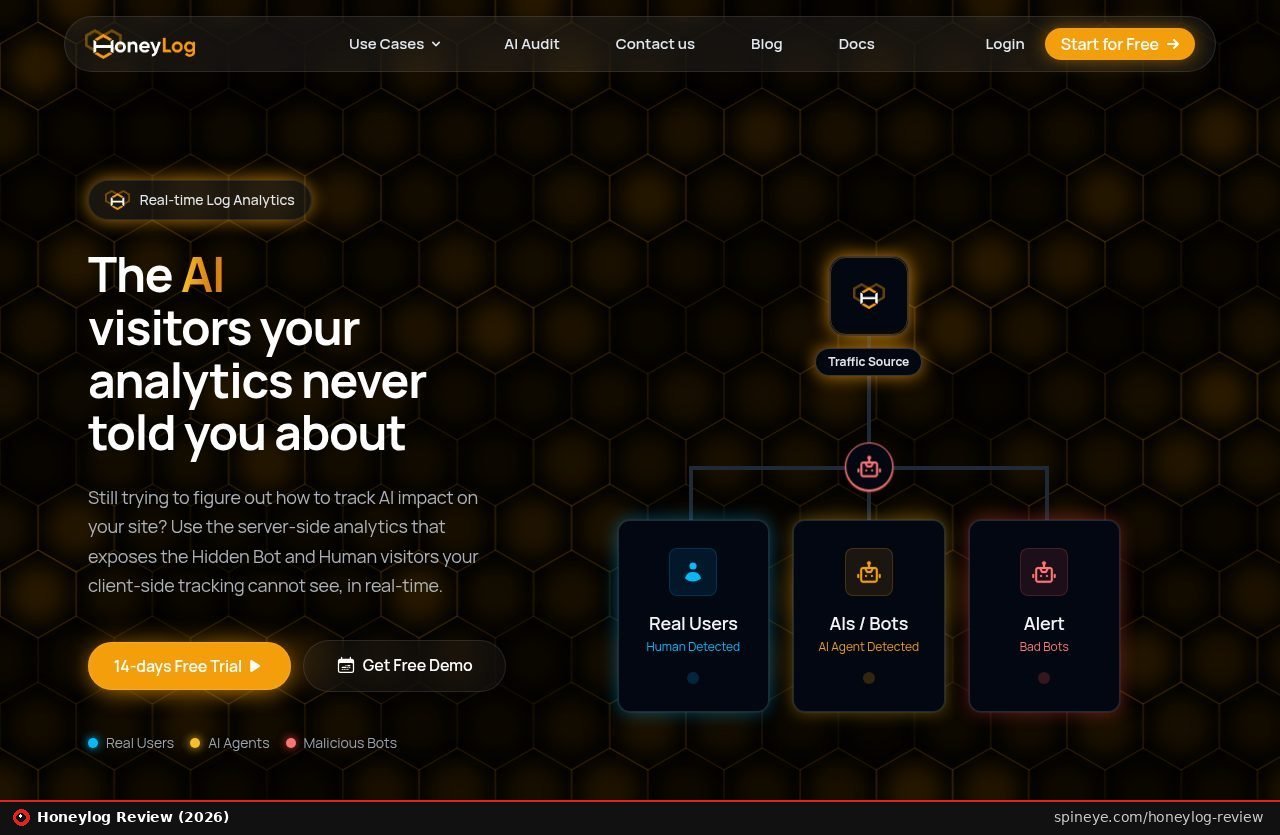
Honeylog is a server-side analytics tool that ingests your web server or CDN logs and classifies every request by who made it: a named AI crawler, a search bot, a spoofer, a malicious bot or a human. It needs no JavaScript tag, and the makers say most setups take under 30 minutes.
Honeylog was founded on 1 June 2026 in Rome by the SecondBreakfast team, with Lorenzo Diaco as CEO, and launched on AppSumo on 10 September 2026. It fits the kind of small, independent software we look for in our hidden-gem software research: one focused job, done at the log level rather than in the browser.
What it tracks
According to the Honeylog FAQ, it identifies GPTBot (OpenAI), ClaudeBot (Anthropic), PerplexityBot, Google-Extended, Bytespider (ByteDance), CCBot (Common Crawl), Meta-ExternalAgent, Applebot-Extended, Amazonbot and others by name and user agent. Because anyone can put “GPTBot” in a user-agent string, Honeylog checks each claim against the IP ranges that OpenAI, Anthropic, Perplexity, Google and others publish, and flags mismatches as spoofed. That matters: impersonated bots are a classic cover for scrapers, a risk we also saw in the Huntarr security incident, where trusting surface signals went badly wrong.
| Metric | Value | Source |
|---|---|---|
| Log sources | Cloudflare, Fastly, CloudFront, Akamai, Nginx, Apache, Caddy, WordPress plugin | Honeylog FAQ |
| Sitemap re-scan | About every hour | AppSumo FAQ |
| robots.txt check | Once a day, with version history | AppSumo FAQ |
| Alert interval | Every 5 min to once a day | AppSumo FAQ |
| Alert limits | 10 recipients, max 10 e-mails per site per day | AppSumo FAQ |
| Notifications | Slack, Telegram, Google Chat | AppSumo FAQ |
| Data access | Dashboard, API, MCP | Founder answer, AppSumo [12] |
The WordPress route
If you run WordPress without a CDN, there is an official Honeylog plugin (version 1.0.1). It queues front-end requests plus .xml and .txt files locally and sends them to Honeylog every 60 seconds in batches of up to 100, using WP-Cron. Two caveats from its own documentation: it had no reviews yet on wordpress.org, and the developers say it is not the complete integration for WordPress VIP, because edge-cache hits there never run PHP. The same logic applies to any heavily cached site — a CDN log feed sees more than a plugin can. If you are weighing a move to a setup with a proper CDN in front, our shared-to-cloud hosting migration guide walks through it.
3What did early users find with Honeylog?
The first public reports describe the same arc: a slow or confusing first evening, then a “wake-up call” once data accumulates. Users saw Googlebot discover new posts, AI assistants fetch pages, fake-human traffic hiding behind normal browser user agents, and far more 404 errors than their regular analytics had ever shown.
Marketer David Nelson bought Tier 1 and wrote up his first weeks in a detailed hands-on review. His favourite use case surprised him: watching Googlebot actually find his new articles, instead of assuming his sitemap did the job. ChatGPT-User, OAI-SearchBot, PerplexityBot, DuckAssistBot and Claude-User all appeared in his early data.
The most useful lesson in his write-up is about reading the numbers carefully. A headline of four OAI-SearchBot requests looked like OpenAI crawling his content — until he added URL and status-code filters and found all four were requests for robots.txt. Another URL showed 12 bot requests that, once filtered, were all classified as “Fake Human”.
“Much more useful than I expected, but there’s a learning curve.”— davenelson, verified Tier 1 buyer, 4/5 on AppSumo [4], 17 September 2026
The second public review tells the story from the other side. A Tier 3 buyer credited the founder with guiding the setup personally, even over a weekend, and moved his nameservers to Cloudflare for the first time to make it work. What he saw afterwards — bots, fake users and spammy IPs — convinced him his site needed changes.
“It felt like I’d been sleeping in a bed of snakes.”— verified Tier 3 buyer, 5/5 on AppSumo [5], 19 September 2026
Not everyone got that far quickly. In the public AppSumo questions [13], a user on the Dorik site builder asked whether Cloudflare was required. The founder explained that logs must arrive through a CDN or from the server itself, and offered to help by e-mail. For hosted builders without log access, that means adding Cloudflare in front first.
4How much does Honeylog cost?
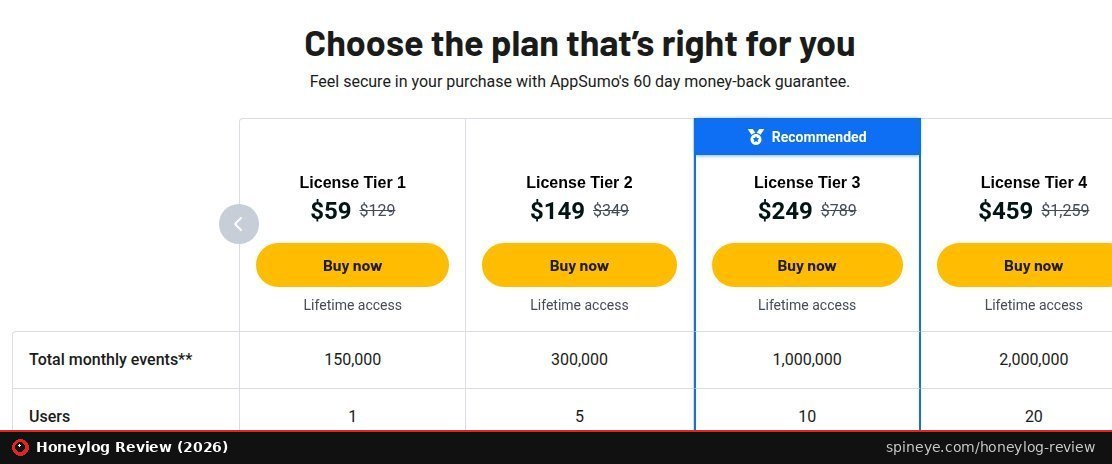
On AppSumo, a lifetime Honeylog licence currently costs $59 for Tier 1 (one site, 150,000 events a month) up to $799 for Tier 5, with a 60-day refund. Regular subscriptions start at €49 a month for the Lite plan, and every plan has a 14-day free trial without a credit card.
| AppSumo tier | Price (list) | Events / month | Sites | Retention |
|---|---|---|---|---|
| Tier 1 | $59 ($129) | 150,000 | 1 | 6 months |
| Tier 2 | $149 ($349) | 300,000 | 5 | 1 year |
| Tier 3 | $249 ($789) | 1,000,000 | 10 | 1 year |
| Tier 4 | $459 ($1,259) | 2,000,000 | 20 | 1.5 years |
| Tier 5 | $799 ($1,899) | Enterprise plan features | ||
Source: AppSumo listing, checked 23 September 2026. Tier 3 and up add API access and custom alerts. One reviewer reported Tier 1 at $49 a week earlier, so the deal price has changed since launch. The deal is for new Honeylog users only and must be activated within 60 days.
Outside AppSumo, the official pricing page lists Lite at €49 a month (€490 a year) and Business at €79 a month (€790 a year) at the 500,000-events step, with Enterprise on request. Lifetime deals only make sense if the company is still around in a few years — a fair question for any four-month-old start-up, and one we raised in our Accordio review as well.
Tier 1 is currently $59 on AppSumo for one site and 150,000 events a month, with a 60-day refund.
Check the current Honeylog deal
5Honeylog pros and cons
Honeylog’s strengths are the data it exposes and a flexible report builder. It names AI crawlers, checks for spoofers, and surfaces 404s and fake-human traffic, backed by an unusually responsive founder. Its weaknesses are those of a four-month-old product: a rough onboarding, thin documentation, a new WordPress plugin, and a setup that assumes log or CDN access.
Pros
- Shows traffic JavaScript analytics cannot, from AI crawlers to 404s (source [6])
- Checks claimed bots against official IP ranges to catch spoofers (source [1])
- Report builder lets you drill into URL, status code and response time (source [4])
- Founder helps with setup directly, including weekends (source [5])
- Daily robots.txt history and hourly sitemap checks (source)
- 60-day refund on the AppSumo deal (source)
Cons
- First run can stall on “waiting for first aggregation” with no time estimate (source [6])
- Better at showing what happened than telling you what to do (source [4])
- No documented explanation of what triggers a “Fake Human” label (source [6])
- Needs log or CDN access; hosted builders require Cloudflare first (source [11])
- WordPress plugin is at version 1.0.1 with no reviews yet (wordpress.org/plugins/honeylog-ingestion)
- Founded June 2026 — no long-term track record yet (source)
6Should you allow or block AI crawlers?
It depends on the bot’s purpose. Search and user-action bots such as OAI-SearchBot, Claude-SearchBot and ChatGPT-User are what get you cited in AI answers, so blocking them costs visibility. Training-only crawlers are a business decision. Honeylog’s value is that it shows which of these actually visit you, and whether they obey your robots.txt.
Plenty of sites have already decided. GPTBot is now the agent most often named in robots.txt files: 827 top domains in Cloudflare Radar’s scan of 24 August 2026, ahead of ClaudeBot at 726. And 24.0% of all crawler requests worldwide got a 403 in August, up from 20.1% in January (SEOmator). The payoff from allowing bots is thin but real: a Stanford Graduate School of Business study summarised in the same report put click-through rates at 0.33% for AI chatbots and 0.74% for AI search engines, against 8.6% for Google Search.
A robots.txt that blocks training but keeps citations
Each AI company runs separate bots for separate jobs, so you can opt out of model training and still appear in AI answers. The bot names and roles below come from the Cloudflare Radar bot directory as summarised by SEOmator (28 August 2026). robots.txt is a request, not a wall — which is why checking the logs afterwards matters.
# Training crawlers: opt out
User-agent: GPTBot
Disallow: /
User-agent: ClaudeBot
Disallow: /
User-agent: CCBot
Disallow: /
User-agent: Bytespider
Disallow: /
User-agent: Meta-ExternalAgent
Disallow: /
# Search and user-action bots: allow (citations and visits)
User-agent: OAI-SearchBot
Allow: /
User-agent: ChatGPT-User
Allow: /
User-agent: Claude-SearchBot
Allow: /
User-agent: Claude-User
Allow: /
User-agent: PerplexityBot
Allow: /
Adjust the list to your own business case — a publisher negotiating licences may decide differently from a shop that wants every mention it can get.
A block rule is only as good as your ability to check it. Honeylog’s daily robots.txt fetch and its bot-by-bot view let you see whether a crawler you disallowed still turns up — which is exactly the kind of evidence self-hosters value. If you run your own services, the same “measure before you trust” mindset runs through our Brows3 and Dawarich reviews.
7Honeylog review verdict: who is it for?
Honeylog suits site owners, SEO and GEO practitioners and agencies who can reach their server logs or run Cloudflare, and who want hard evidence of which AI bots read their content. It is less suited to marketers who want ready-made advice, or to anyone on a hosted builder without CDN access.
The early community sentiment is positive but measured: 4.5 out of 5 from two verified AppSumo buyers, and 3.6 out of 5 in the one independent review so far. Both reviewers are keeping the product. Both also say its value comes from letting data accumulate on your own site, which is what the 60-day refund window is for.
Good fit: publishers weighing AI licensing, SEO and GEO specialists who want to see crawler behaviour page by page, agencies reporting to clients, and technically minded owners of WordPress sites or anything behind Cloudflare. If you like tools such as Obtainium that give you control instead of hiding the plumbing, Honeylog has the same spirit.
If you want a tool that turns search data into fixes rather than showing raw logs, our Nuwtonic review covers an agentic SEO and GEO platform that works from your Search Console data.
Poor fit: anyone who wants a dashboard that tells them what to fix, and sites on platforms that give no log access and no CDN option. If your interest in AI is more about agents working for you than bots reading you, our jurniti review covers that side.
Tier 1 is currently $59 for one site and 150,000 events a month, with a 60-day refund.
See the Honeylog deal
About this Honeylog review
- Basis: public documentation (honeylog.io, the pricing page and FAQ), the AppSumo listing, its two verified reviews and public Q&As, the WordPress.org plugin page, and one independent hands-on review.
- Market data: Cloudflare Radar figures for January–August 2026 as compiled by SEOmator, Cloudflare’s 2025 crawl-to-click analysis, and the HTTP Archive Web Almanac 2025.
- Checked: prices and plan limits on 23 September 2026; these can change.
- No score: without our own long-term test, we report community sentiment instead of a rating. How we review.
Frequently asked questions
Is Honeylog worth it?
For site owners who can feed it server or CDN logs and want to see AI crawlers by name, early users say yes: both verified AppSumo buyers kept the product. If you need step-by-step advice rather than raw data, the current version may frustrate you.
Does Honeylog replace Google Analytics?
No. It complements it. Google Analytics shows what human visitors do; Honeylog shows every request that reaches your server, including bots that never run JavaScript.
Which AI crawlers does Honeylog detect?
GPTBot, ClaudeBot, PerplexityBot, Google-Extended, Bytespider, CCBot, Meta-ExternalAgent, Applebot-Extended, Amazonbot and others, by name and user agent, with spoof checks against published IP ranges.
Does Honeylog work with WordPress?
Yes, through the official honeylog-ingestion plugin or through a CDN such as Cloudflare. The plugin is new (version 1.0.1), and on heavily cached sites a CDN log feed captures more.
How much is the Honeylog lifetime deal?
Tier 1 currently costs $59 on AppSumo for one site and 150,000 events a month, with higher tiers up to $799 and a 60-day refund.
Should I block AI crawlers?
Block by purpose, not wholesale. Search and user-action bots bring citations and visits; training-only crawlers are a business choice. A log tool such as Honeylog shows which ones actually visit and whether they respect robots.txt.
Sources
- Honeylog — homepage and FAQ. honeylog.io/faq
- Honeylog — pricing. honeylog.io/pricing
- AppSumo — Honeylog listing, plans, FAQ and Q&A (checked 23 Sep 2026). appsumo.com/products/honeylog
- AppSumo review — “Much more useful than I expected, but there’s a learning curve” (17 Sep 2026). link
- AppSumo review — “Interesting Tool Great Customer Service” (19 Sep 2026). link
- David Nelson — HoneyLog Review, Marketing with Dave (18 Sep 2026). marketingwithdave.com/honeylog-review
- WordPress.org — Honeylog plugin (honeylog-ingestion 1.0.1). wordpress.org/plugins/honeylog-ingestion
- SEOmator — Monthly AI Crawler Report, July 2026, with Cloudflare Radar data to 28 Aug 2026. seomator.com/blog/ai-crawler-report
- Cloudflare — The crawl-to-click gap (2025). link
- HTTP Archive — Web Almanac 2025, Page Weight. link
- AppSumo — questions/dorik integration 1549392. link
- AppSumo — questions/getting started 1549502. link
- AppSumo — questions/dorik setup 1549677. link
AI assistance was used for research and drafting; every fact was checked against the listed sources. Prices checked 23 September 2026.